The Current Situation in India: Freedom and equality are fundamental human rights. Social and economic equality is a civic right for the citizens of a free nation. India falls into the category of free nations, yet vast social and economic inequality prevails within the country. This inequality reveals the existence of two distinct classes in India: the ruled class (Bahujan Samaj)—which is the victim of this inequality, or the exploited—and the ruling class—which perpetrates this inequality, or the exploiter. The ruling class constitutes 10 to 15 percent of the country’s population, whereas the ruled/exploited class comprises 85 to 90 percent.
(a) Economic Inequality:
1. According to the CIA World Factbook, India is a country characterized by extreme inequality. This situation stems from the unequal distribution of national wealth and income. The wealthiest 1 percent of the population holds more than 50 percent of the country’s wealth; in contrast, during the British Raj (prior to 1947), the top 1 percent held only 25 to 30 percent of the national wealth. Today, the wealthiest 10 percent possess 80.7 percent of the wealth. This trend is intensifying year by year. Credit Suisse’s Global Wealth Data Book presents further data that is truly alarming. In terms of social hierarchy, the bottom 10 percent of the population holds only 0.2 percent of the national wealth; the next 10 percent holds only 0.4 percent; and the 10 percent above them holds only 0.8 percent. In other words, the bottom 30 percent of the population, based on social standing, possesses only 1.4 percent of the country’s national wealth. This implies that the divide between rich and poor in India is caste-based. Under the Brahminical system, castes with lower status are poor, while those with higher status are wealthy.
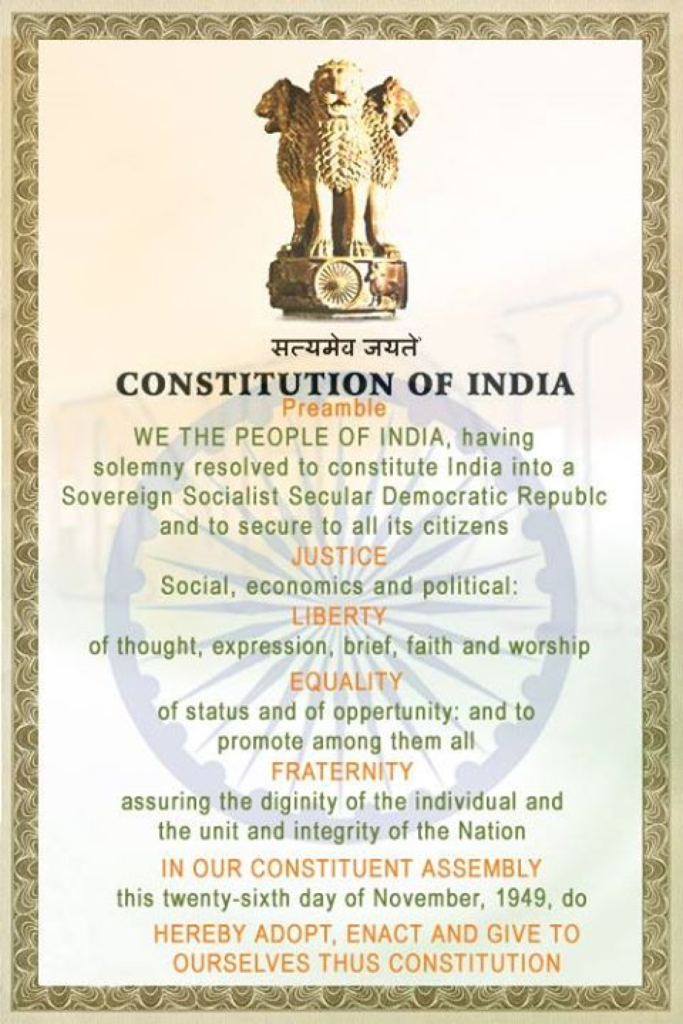
Constitutional provisions to address economic inequality: The Indian Constitution contains comprehensive provisions to eliminate inequality; some of these are listed below:
(a) Article 38(2) of the Constitution: According to this article, the “State” shall strive to minimize inequalities in income; meaning, the government bears the responsibility of eliminating income disparities among Indian citizens.
(b) Article 39(c) of the Constitution: According to this article, the economic system should operate in such a way that the concentration of wealth and means of production does not occur to the detriment of the common good.
(c) Article 47 of the Constitution: According to this article, it is the duty of the State—that is, the government—to raise the level of nutrition and the standard of living and to improve public health.
(d) Article 45 of the Constitution: When the Constitution came into force on January 26, 1950, this article stipulated that the State (government) would provide free and compulsory education to every child in the country up to the age of 14.
3. Central and state governments failed to implement the Constitution fully or appropriately; consequently, inequality increased rather than decreased.
(b) Social inequality: Social inequality in India is based on the Brahminical system. Regarding social inequality…
Such instances are witnessed day in and day out—for example, urinating or spraying urine on Dalits, Adivasis, or members of backward classes, or forcing people from backward classes to wash one’s feet and then drink that water. Other examples include the murder and rape of Dalits and Adivasis, throwing a shoe at the Chief Justice of the Supreme Court, and harassing a senior IPS officer to the point of suicide. The monstrous scale of this issue can be gauged by comparing it to the Nirbhaya rape case (Delhi) and the Hathras (Uttar Pradesh) rape and murder incident.
Social and economic inequality lies at the root of every problem faced by the Bahujan society.
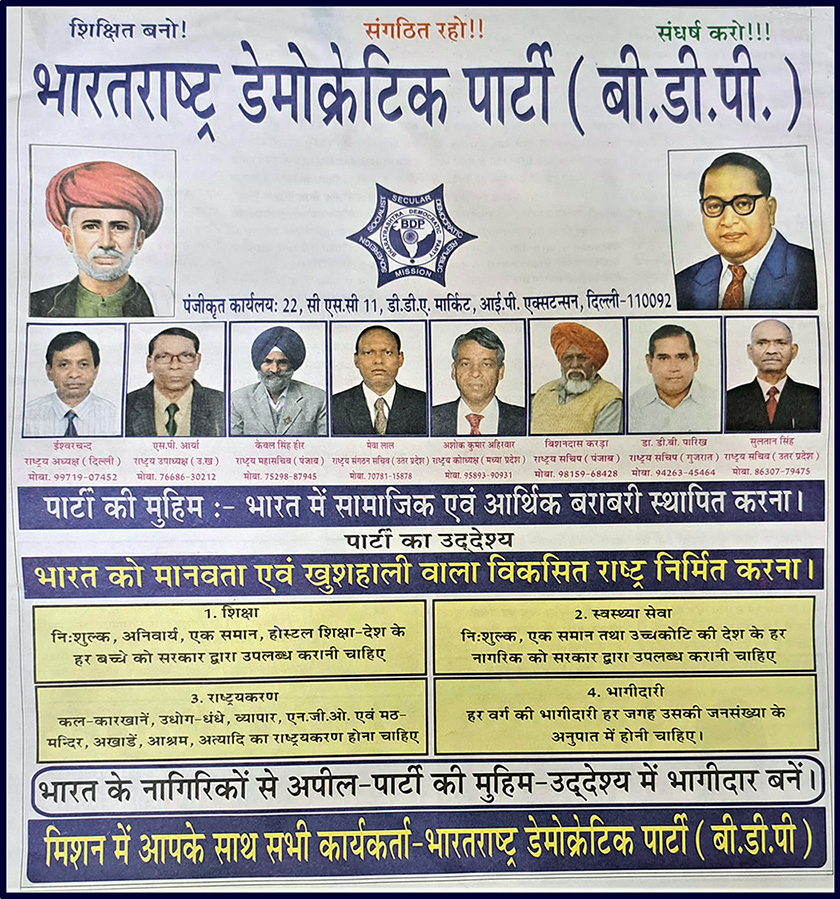
Agenda of the Bharatrashtra Democratic Party (BDP): The BDP is committed to transforming India into a developed nation characterized by humanity and prosperity. To achieve this, brotherhood must be established in the country, and establishing brotherhood requires establishing equality. Therefore, the BDP will establish social and economic equality in India. To achieve this equality, it will first implement the following schemes:
1. Education: In India, education will be provided by the government—free of cost, compulsory, uniform, and under one roof (residential/hostel-based)—to every child in the country (regardless of caste, religion, or region) between the ages of 4 and 18. When a student moves to higher education after the age of 18 through a competitive process, that higher education will also be provided by the government free of cost. Private educational institutions will be nationalized.
2. Healthcare: In India, high-quality healthcare will be provided by the government to every citizen (regardless of caste, religion, or region) on a mandatory and equal basis. To this end, every village will have a health center equipped with medicines and qualified doctors; the block level will have a hospital featuring full facilities and qualified doctors; and every district headquarters will have a super-specialty hospital. Private hospitals and institutions will be nationalized.
3. Nationalization: To eliminate economic inequality, the means of production and income sources will be nationalized. All factories, industrial and commercial enterprises, businesses, religious establishments (maths, temples, akharas, ashrams), NGOs, etc., will be nationalized. 4. Participation – India is a caste-dominated country. Therefore, to eradicate corruption and establish good governance in India, participation in proportion to their population will be ensured for every caste-based category (such as SC, ST, OBC, Dalits, Backward Classes, and religious minorities like Muslims, Christians, etc.) in all controlling positions and across every department, from top to bottom.
We appeal to all citizens of India to join our campaign to build a developed nation characterized by humanity and prosperity, and to fulfill their social and national obligations by actively participating in this endeavor.
All activists with you in the mission – “Bharatrashtra Democratic Party”
| Ishwar Chand (National President) Location: Delhi 9971907452 | S.P. Arya (National Vice President) Location: Roorkee (Uttarakhand) 7668630212 | Kewal Singh Heer (National General Secretary) Location: Hoshiarpur (Punjab) 8427164945 | Mewa Lal (National Organizing Secretary) Location: Saharanpur (U.P.) 9219121320 | A.K. Ahirwar (National Treasurer) Location: Bhopal (Madhya Pradesh) 9589390931 |
| Sultan Singh (National Secretary) Location: Saharanpur (U.P.) 9410289416 | Dr. D.B. Parikh (National Secretary) Location: Gandhinagar (Gujarat) 9913437754 | Bishandas Karda (National Secretary) Location: Mahilpur (Punjab) 9815968428 | Ajit Ram (State President, Punjab) Location: Hoshiarpur (Punjab) 9501863427 | Jitendra Bauddh (State President, U.P.) Location: Jaunpur (U.P.) 9628747868 |
| Dr. Jitendra Bauddh (Member, CEC) Location: Jaunpur (U.P.) 9838946434 | Dr. J.H. Mayavanshi (Coordinator, Gujarat-Maharashtra) Location: Vadodara (Gujarat) 9426327631 | Ashok Mittar (Member, CEC) Location: Bahraich (U.P.) Mobile: 9918361281 |